
Understanding and Sharing the Compounder Score
Learn what the 0–100 Compounder Score means, how its five components are calculated, and how to share or embed a stock's score on your blog or newsletter.
Last updated July 5, 2026
What Is the Compounder Score?
The Compounder Score is a transparent quality rating from 0 to 100, designed specifically for long-term, value-focused investors. Rather than measuring growth or momentum, it focuses on the financial quality and stability of a business — inspired by principles from Piotroski F-Score and Buffett/Munger-style investing.
Unlike many competitor ratings, the Compounder Score publishes its full methodology so you can see exactly how every score is calculated and, if you wish, challenge the thresholds yourself.
How the Score Is Calculated
The score is made up of five components, each worth up to 20 points, for a maximum total of 100:
- Profitability — based on Return on Equity
- Capital Structure — based on Debt-to-Equity ratio
- Cash Quality — based on Free Cash Flow margin
- Valuation — based on Earnings yield
- Stability — based on consistency of the above metrics over time
For each component, the methodology page shows the financial formula, the score bands (which numbers map to which point values), and an explanation of why that factor matters for long-term investors. Growth metrics and sector adjustments are deliberately excluded.
Interpreting Score Tiers
Use this quick reference to understand what a score means at a glance:
- 75–100 — Excellent: Strong across most or all quality dimensions
- 50–75 — Solid: Good overall quality with some areas to watch
- 25–50 — Mixed: A blend of strengths and weaknesses
- 0–25 — Weak: Significant quality concerns across multiple factors
On a stock's public score page, you'll see the overall score out of 100, a quality tier badge (Excellent, Solid, Mixed, or Weak), and a card for each of the five components with a progress bar showing its individual score out of 20.
Exploring the Methodology Page
To dive deeper into how the score works, navigate to the Compounder Score Methodology page (found in the education or methodology section of the product). There you can:
- Read the overview to understand the score's purpose and background
- Review each of the five components in detail — including formulas, score bands, and rationale
- Check the score tier reference table
- Watch an educational course video for a guided walkthrough
- Click See it on real stocks to view scores applied to actual companies
Viewing a Stock's Score Without Logging In
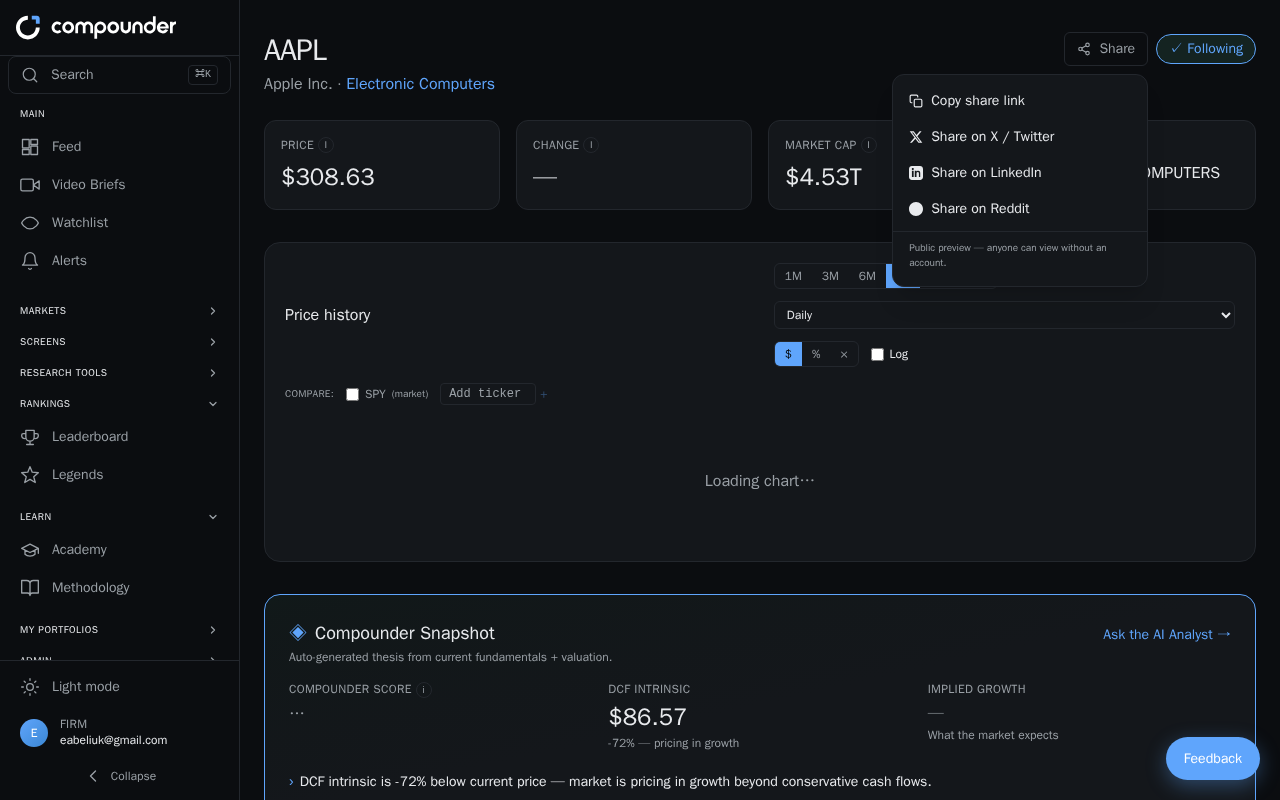
Every stock has a public, shareable score page that anyone can view — no account required. You can reach it via a share link from within the app, or by going directly to a URL in the format compounderflow.com/share/[TICKER] (for example, compounderflow.com/share/AAPL).
The page displays:
- The stock ticker and company name
- The overall Compounder Score out of 100 and its quality tier badge
- A breakdown of all five component scores as cards with progress bars
- The date when the underlying fundamentals were last updated
- A link to the full methodology
If a stock hasn't been analyzed yet, the page will show Not yet in coverage.
From this page you can also click See the full breakdown for detailed analysis (this requires logging in), or Create a free account to get started.
Sharing or Embedding a Score on Your Blog or Newsletter
If you write about stocks on a blog, Substack, or Notion page, you can embed a live score widget that updates automatically as a company's fundamentals change.
- Navigate to the stock's public share page (via the app's share link or the direct URL).
- Locate the Copy embed code button on the page.
- Click it — the embed snippet is copied to your clipboard.
- Paste the snippet into your blog editor, Substack post, or Notion page.
- The widget will display the stock's current Compounder Score and will automatically refresh whenever the underlying fundamentals are updated — no manual work required on your end.