
Comparing Quality Scoring Systems: Compounder Score, F-Score, and Z-Score
Learn how the three quality scoring systems differ in purpose and when to use each one for your investment analysis.
Last updated July 6, 2026
Overview
The platform offers three distinct quality scoring systems — the Compounder Score, the Piotroski F-Score, and the Altman Z-Score. While all three help you evaluate a company's financial health, they answer very different questions. Using the right score for your specific analysis can make a meaningful difference in your conclusions.
To explore these systems together, navigate to the Score Comparison page, found within the methodology or education area of the platform.
What Each Score Answers at a Glance
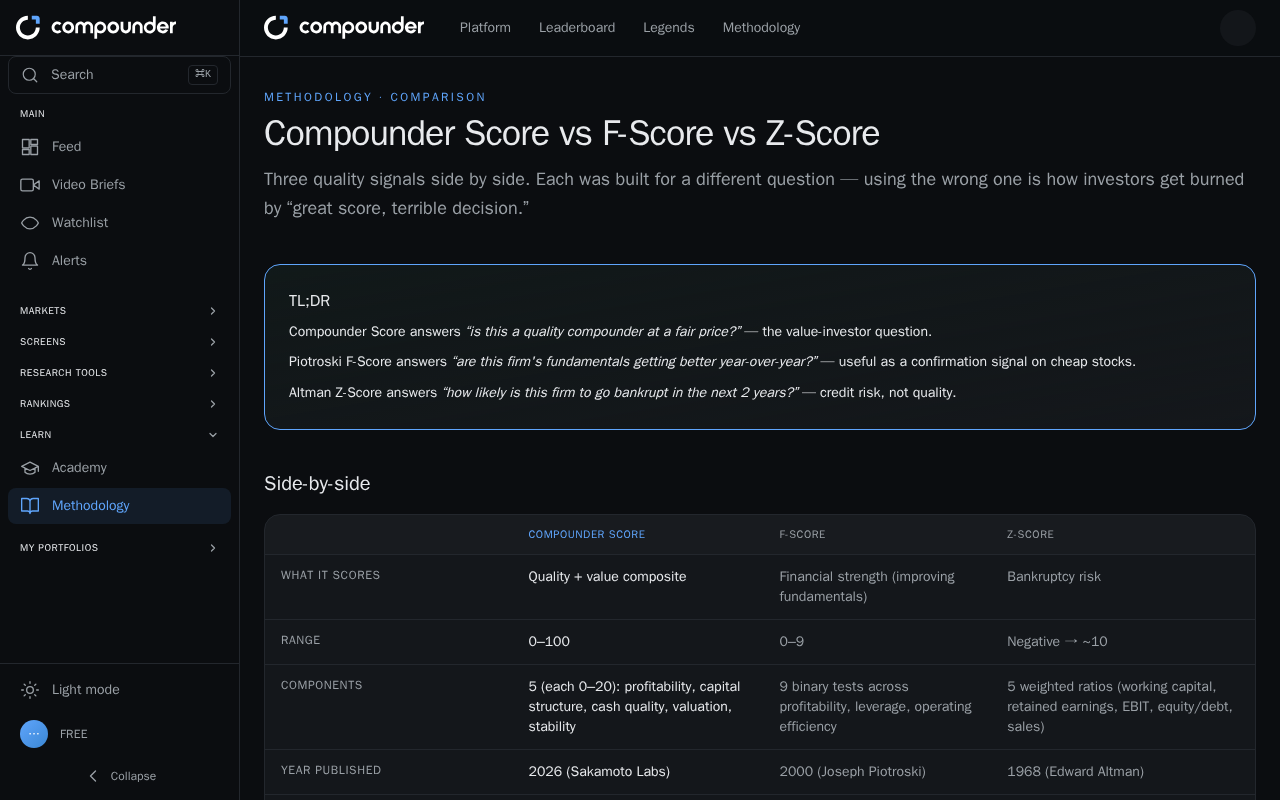
The Score Comparison page opens with a TL;DR section that cuts straight to the point:
- Compounder Score — Is this a quality compounder at a fair price?
- F-Score (Piotroski) — Are fundamentals improving year-over-year?
- Z-Score (Altman) — How likely is bankruptcy in the next two years?
These three questions reflect genuinely different investment concerns, which is why no single score fits every situation.
Understanding the Side-by-Side Comparison Table
Below the TL;DR, a detailed comparison table lays out all three scores across 11 dimensions. On mobile, each score gets its own column for easy reading. The table covers:
- What each score measures
- Score range and number of components
- Who created it and when
- Original intended use
- Whether valuation and consistency are factored in
- Sector adjustments
- Transparency of the methodology
- What each score signals best
- Common pitfalls to watch out for
Reviewing this table is the fastest way to understand where each score comes from and what it was designed to do.
When to Use Each Score
After the comparison table, the page walks through three dedicated sections explaining the ideal use case for each score.
Compounder Score — Long-Term Ownership Decisions
Use the Compounder Score when you want to evaluate whether a company is a high-quality business trading at a reasonable price. It combines quality and valuation into a single signal, making it well-suited for long-term investment decisions where you care about both what you're buying and what you're paying for it.
F-Score — Confirming Improving Fundamentals
The Piotroski F-Score is best used as a confirmation filter, particularly on stocks that already look cheap by other measures. It tells you whether a company's underlying financials are trending in the right direction year-over-year. A strong F-Score on a low-priced stock can be a meaningful signal; a strong F-Score alone, without other context, is less conclusive.
Z-Score — Spotting Bankruptcy Risk
The Altman Z-Score was designed specifically to flag distress and the likelihood of bankruptcy within roughly two years. It is a warning tool, not a quality signal — a high Z-Score means lower bankruptcy risk, but it does not mean the company is a great investment. Avoid using it as a substitute for the other scores when assessing overall business quality.
Getting More Detail
If you want to go deeper on any individual score, the Score Comparison page includes links to the full methodology documentation and investment consensus data, so you can explore the underlying components at your own pace.